Showing posts with label business statistics. Show all posts

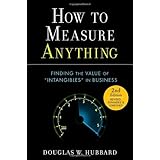
How to Measure Anything: Finding the Value of Intangibles in Business Review

How to Measure Anything: Finding the Value of Intangibles in Business
Average Reviews:

(More customer reviews)
Are you looking to buy How to Measure Anything: Finding the Value of Intangibles in Business? Here is the right place to find the great deals. we can offer discounts of up to 90% on How to Measure Anything: Finding the Value of Intangibles in Business. Check out the link below:

>> Click Here to See Compare Prices and Get the Best Offers

How to Measure Anything: Finding the Value of Intangibles in Business ReviewSome things are easy to measure. Time, money, exercise, calories, location - all of these are relatively straightforward to repeatably determine or calculate.
But how does one go about measuring happiness? What about compassion, or public influence, or creativity? These are more intangible, harder to pin down to a number that means anything.
Douglas Hubbard has written an impressive work called "How To Measure Anything: Finding the Value of Intangibles in Business."
While it's written primarily for business people, the lessons transfer smoothly to self-experimenters. Hubbard begins with a compelling case for why to measure intangibles:
"Often, an important decision requires better knowledge of the alleged intangible, but when a [person] believes something to be immeasurable, attempts to measure it will not even be considered.
As a result, decisions are less informed than they could be. The chance of error increases. Resources are misallocated, good ideas are rejected, and bad ideas are accepted. Money is wasted. In some cases life and health are put in jeopardy. The belief that some things--even very important things--might be impossible to measure is sand in the gears of the entire economy.
Any important decision maker could benefit from learning that anything they really need to know is measurable."
He goes on to explain in detail how to measure intangibles, including sections on how to clarify problems, calibrate estimates, measure risk, sample reality, and use Bayesian statistics to add to available knowledge. He also describes his Applied Information Economics (AIE) Approach that ties together several threads of his ideas:
"The AIE approach addresses four things:
1. How to model a current state of uncertainty
2. How to compute what else should be measured
3. How to measure those things in a way that is economically justified
4. How to make a decision"
I'm working my way through the book, and am incredibly grateful to Douglas Hubbard for writing it.How to Measure Anything: Finding the Value of Intangibles in Business Overview

Want to learn more information about How to Measure Anything: Finding the Value of Intangibles in Business?

>> Click Here to See All Customer Reviews & Ratings Now
Read More...

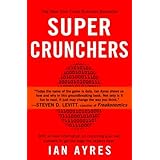
Super Crunchers: Why Thinking-By-Numbers is the New Way To Be Smart Review

Super Crunchers: Why Thinking-By-Numbers is the New Way To Be Smart
Average Reviews:

(More customer reviews)
Are you looking to buy Super Crunchers: Why Thinking-By-Numbers is the New Way To Be Smart? Here is the right place to find the great deals. we can offer discounts of up to 90% on Super Crunchers: Why Thinking-By-Numbers is the New Way To Be Smart. Check out the link below:

>> Click Here to See Compare Prices and Get the Best Offers
Super Crunchers: Why Thinking-By-Numbers is the New Way To Be Smart ReviewIs it a new brand of cereal? Or maybe it's a granola bar, or a chunky peanut butter spread? Then again, could it be the latest infomercial exercise device designed to give you the six pack abs you've always dreamed of but know in your heart of hearts you'll never achieve? Actually, it's a book - the title a product of the very methods the book describes. Here's what SUPER CRUNCHERS says.
(1) Mathematical regression models generated from large datasets often generate better predictions than human experts, and they provide supporting information on the predictive weight and reliability of each explanatory variable.
(2) Well-crafted experiments using randomized trials and control groups provide good market research and behavioral analysis results.
(3) Technological advances - the Internet, massive data storage devices, rapid computation, broadband telecommunication - are making it possible to share more sources of information and create ever-larger databases for analysis.
(4) Today's companies engage in multiple forms of market research by creating and using large databases and large-scale randomized trials.
(5) Many phenomena conform to normal distributions in which 95% of the population will be found within two standard deviations of the mean, the5% balance generally divided evenly in the two tails.
That's it. I just saved you $25.00 U.S. and a half-dozen or more hours learning how a guy from Yale named Ian Ayres collected a bit of information about applied mathematical techniques that have been in practical use for decades, packaged them up, palmed them off as something new, and cooked up the ridiculous name Super Crunching to describe an ostensibly new technological development. Yet "Super Crunching" is nothing more than the author's marketing hype for a couple of standard mathematical methodologies, a creation of nothing from something. There's no new breakthrough here, no new paradigm.
Yes, the anecdotal information about the future prices of wine vintages, Capital One's teaser offerings, and evidence-based medical diagnosis are interesting (hence the two stars rating). The rest, however, is neither prescriptive nor sufficiently critically analytical. Should we go out shopping for a Super Cruncher tomorrow? Should we delight in the increased accuracy of data-driven modeling and prediction, or should we fear the implied manipulation of our desires and the incessant, single-minded drive toward maximum profit at the expense of creativity? Do we really want movies and books to be developed from mathematical models like Epagogix? Do we really want our every keystroke on the Internet to be fodder for market research that manipulates us in response? John Kenneth Galbraith, among others, warned of exogenous, manufactured demand decades ago.
SUPER CRUNCHERS is part business tome, part econometric paean, and part sociology book, but not fully any of the three. No matter how many time the author uses words like "cool" and "humongous" and "amazing," it's still regrettably a "No Sale" even for someone like me who enjoys reading about applied mathematics.
Super Crunchers: Why Thinking-By-Numbers is the New Way To Be Smart Overview

Want to learn more information about Super Crunchers: Why Thinking-By-Numbers is the New Way To Be Smart?

>> Click Here to See All Customer Reviews & Ratings Now
Read More...